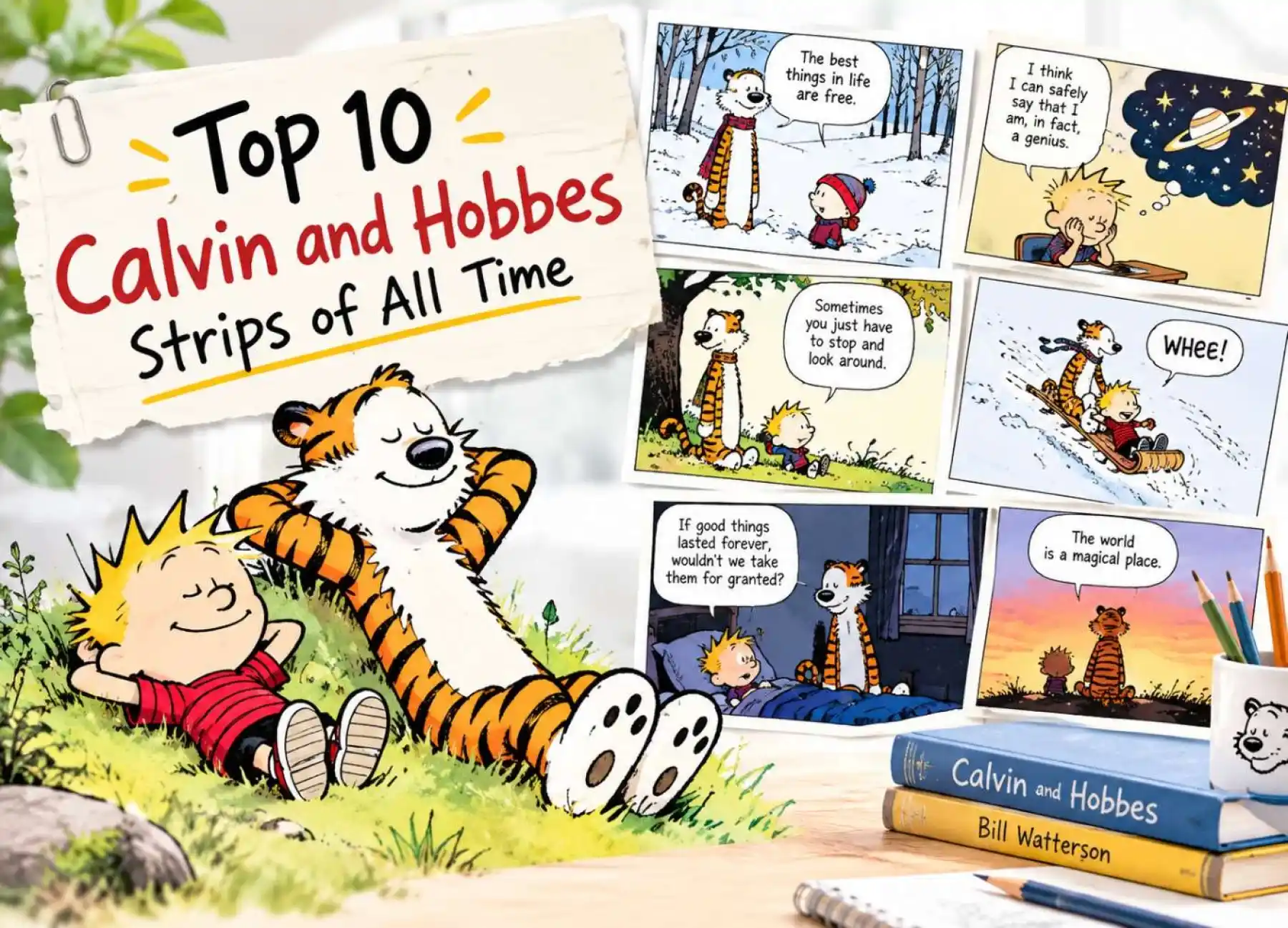

The top 10 Calvin and Hobbes strips of all time are defined by Bill Watterson’s rare ability to blend high-concept philosophy, childhood imagination, and stunning visual layout into a few simple print panels. While the legendary daily feature originally ran in newspapers for exactly ten years between November 1985 and December 1995, it managed to establish a lasting artistic standard that modern webcomics still struggle to match.
Choosing the absolute best moments from a historic catalogue of 3,160 individual daily strips requires analyzing both the laugh-out-loud physical comedy and the quiet, deeply emotional Sunday specials.
+-----------------------------------+--------------------+------------------------+

| Strip Focus Area                  | Key Debut Year     | Core Creative Element  |
+-----------------------------------+--------------------+------------------------+

| The Imagination Gadget Inventions | 1987               | Cardboard box geometry |
| The Deep Existential Wagon Rides  | 1988               | High-speed motion blur |
| The Social Commentary Snowmen     | 1993               | Macabre backyard art   |
| The Emotional Dramatic Arcs       | 1989               | Wordless pacing panels |
+-----------------------------------+--------------------+------------------------+
What Makes a Calvin and Hobbes Strip Truly Timeless?
Most daily comic features rely entirely on repetitive setups and familiar punchlines to survive the grinding pressure of daily publication. Watterson took a completely different path. He fought the print syndicates for years to secure absolute creative control over his Sunday layouts, allowing him to discard standard panel grids whenever a grand visual idea required more physical space on the newspaper page.
Think of it as a masterclass in perspective. One morning you are looking at a hyper-detailed drawing of a Tyrannosaurus Rex flying an F-14 Tomcat fighter jet, and the next morning you are reading a quiet dialogue about environmental decay while two characters drift through a swamp on a log raft.
The underlying magic relies on the contrast between the two central figures. You have an incredibly energetic six-year-old boy filled with unearned confidence, balanced perfectly by a stuffed tiger who represents calm, pragmatic adult reason.
The Top 10 Calvin and Hobbes Strips of All Time Ranked
10. The Scientific Progress Goes ‘Boink’ Duplicator Incident
This iconic storyline from 1990 highlights exactly what happens when Calvin tries to solve his household chores using an upside-down cardboard box. Instead of cleaning his room, he creates an army of duplicate clones that inherit only his worst behavioral traits.
The specific strip where his mother discovers four identical Calvins trying to eat dinner while shouting nonsense words is a masterclass in chaotic comic framing. It perfectly captures the sheer panic of parenting an out-of-control imagination.
9. The Transmogrifier Gun Debut
Long before the box became a duplicator or a time machine, it debuted in 1987 as a simple device that could transform any living creature into a completely different animal species.
The single panel where Hobbes accidentally turns Calvin into a tiny, insecure frog wearing an oversized red-and-black striped t-shirt remains one of the most memorable visual gags from the early years of the run. Watterson’s character expressions say more in a single box than most modern graphic novels manage in an entire page.
8. The Tragic Little Raccoon Storyline
In May 1989, the strip took a sharp detour into deep, genuine grief. Calvin finds an injured baby raccoon in the woods behind his house, brings it to his parents, and watches it pass away despite their best medical efforts.
Notable Narrative Shifts in the Raccoon Arc:
• Panel 1: Calvin processes the reality of death for the very first time.
• Panel 2: A quiet, wordless hug between a boy and his mother.
• Panel 3: Hobbes reminds us that a tiger's love is unconditional.
This specific storyline proved that a daily newspaper comic could handle serious human vulnerability without relying on cheap sentimentality or easy jokes.
7. The Roslyn Babysitter Battle Plan
Roslyn was the only human being capable of striking genuine terror into Calvin’s heart. Every time his parents went out for a nice dinner at a local restaurant, a high-stakes standoff erupted in the suburban living room.
The definitive strip in this series involves Calvin locking himself in the bathroom for over two hours while trading increasingly ridiculous demands through the keyhole. It is a brilliant, highly accurate look at childhood defiance meeting an immovable psychological wall.
6. Calvin Explores the Meaning of Art with Snowmen
Here’s the thing about the famous winter snowman strips. They weren’t just funny visual setups; they were an intentional critique of the modern art market and social conformity.
Our absolute favorite panel features an elaborate, macabre display of dozens of tiny snowmen fleeing down the driveway away from a giant, menacing snow-monster holding a shovel. Neighbors would look out their windows in mock horror, illustrating the exact moment where pure childhood creativity bumps against rigid neighborhood expectations.
5. The Great Yukon Sabotage Bedtime Story
In a classic 1989 story, Calvin decides he has had enough of the modern school system and plans an immediate escape to northern Canada. He packs a single duffel bag filled with nothing but comic books, chocolate chip cookies, and a spare pair of socks.
The strip where he sits in the dark backyard at 11:30 PM, shivering in a thin winter coat while realizing he has no idea how to cross the international border, grounds his grand fantasy in hilarious reality.
4. The Philosophical Wagon Ride Down the Steep Hill
Watterson used a simple red toy wagon as a recurring vehicle for deep philosophical dialogues. Calvin and Hobbes would hurtle down a treacherous, rock-filled hillside at 30 miles per hour while casually discussing destiny, morality, and human consciousness.
The layout works because the physical speed of the wagon perfectly mirrors the dangerous velocity of their unchecked intellectual theories. The strip ends with an inevitable crash into a muddy ditch, reminding the reader that theory always hits reality eventually.
5. Tiger Attacks at the Front Door
Every single afternoon, Calvin would walk home from the school bus stop with a heavy backpack weighing down his shoulders. The moment his fingers touched the brass doorknob, Hobbes would launch a full-velocity pounce attack from the darkness of the front hallway.
The visual layout of the 1988 entry—showing a giant blur of orange fur, flying sneakers, and explosive sound effect letters—remains an absolute triumph of hand-drawn action choreography.
2. Chewing Gum and the Infinite Universe
Calvin stares up at a clear, star-filled night sky while sitting on a hill with Hobbes. He ponders the immense, staggering size of the cosmos, only to ruin the deep moment by loudly blowing a massive bubble of pink bubblegum that pops all over his face.
It is a perfect distillation of what this comic does best. It pairs the vast mystery of the universe with the absurd, messy reality of being a six-year-old child.
1. The Final Magic Sunday Strip
The absolute number one spot on any legitimate Top 10 Calvin and Hobbes Strips of All Time list must belong to the final farewell page published on December 31, 1995.
The Final Panel Elements:
• A thick, pristine layer of fresh winter snow covering the landscape.
• A brand-new sled perched at the top of a massive hill.
• The famous final line spoken by a smiling boy: "Let's go exploring!"
Instead of ending with a cynical joke or a sad goodbye, Watterson left his audience with a beautiful message about hope, fresh starts, and the infinite possibilities of a blank piece of paper.
How to Read the Full Archives Today Without Overpaying
If you want to read through these classic panels today, avoid buying individual, out-of-print paperback collections from third-party marketplace sellers who inflate prices for profit.
Instead, invest in The Complete Calvin and Hobbes three-volume hardcover box set. This collection includes every single daily and Sunday strip ever drawn, reproduced directly from the original archival ink plates at a much higher resolution than the faded newsprint pages of the 1990s.
Common Mistakes Fans Make When Analyzing Watterson’s Work
The biggest mistake modern readers make is looking at the strip through a lens of pure nostalgia while ignoring the sharp social satire hidden beneath the surface.
Calvin wasn’t just a mischievous kid getting into trouble. He was a vehicle for Watterson to critique consumer culture, television addiction, and the rigid standardization of public education. When you skip the text bubbles to focus purely on the funny faces, you miss more than half of what makes the work a true artistic masterpiece.
6. FAQ Section
Why did Bill Watterson decide to end the comic strip after only ten years?
Watterson chose to retire the feature at the absolute peak of its popularity because he felt he had accomplished everything he wanted to say within the daily newspaper format. He wanted to avoid the creative stagnation that often happens when a strip runs for forty or fifty years under corporate pressure.
Is there an official animated movie or television show based on the characters?
No, an official animated adaptation does not exist because Watterson consistently refused to license the characters for merchandise, toys, or films. He firmly believed that animation would ruin the specific magic of a reader interpreting the voices on a flat comic page.
Where can I legally read daily Calvin and Hobbes updates online today?
You can read the entire historical catalogue chronologically on the official GoComics network. The platform hosts the verified, high-resolution digital files with the direct permission of the Andrews McMeel Universal syndicate group.
What is the real story behind the name choice for the two main characters?
The characters are named after two prominent historical figures from the fields of theology and philosophy. Calvin is named after the 16th-century theologian John Calvin, who believed in predestination, while Hobbes is named after Thomas Hobbes, the 17th-century political philosopher who held a famously pragmatic view of human nature.
7. Conclusion
The single most useful takeaway when exploring the Top 10 Calvin and Hobbes Strips of All Time is that these pieces are best read as a single, cohesive body of work rather than isolated daily jokes. Taking the time to look past the physical humor reveals a deeply human story about friendship, growing up, and preserving your sense of wonder in a busy world.